
3D Hot-Bent iPhone Screen Protectors: KK9 HD, KK9 HD + AR, and Corning + AR
A three-tier premium glass strategy for brands, distributors, and OEM/ODM buyers.
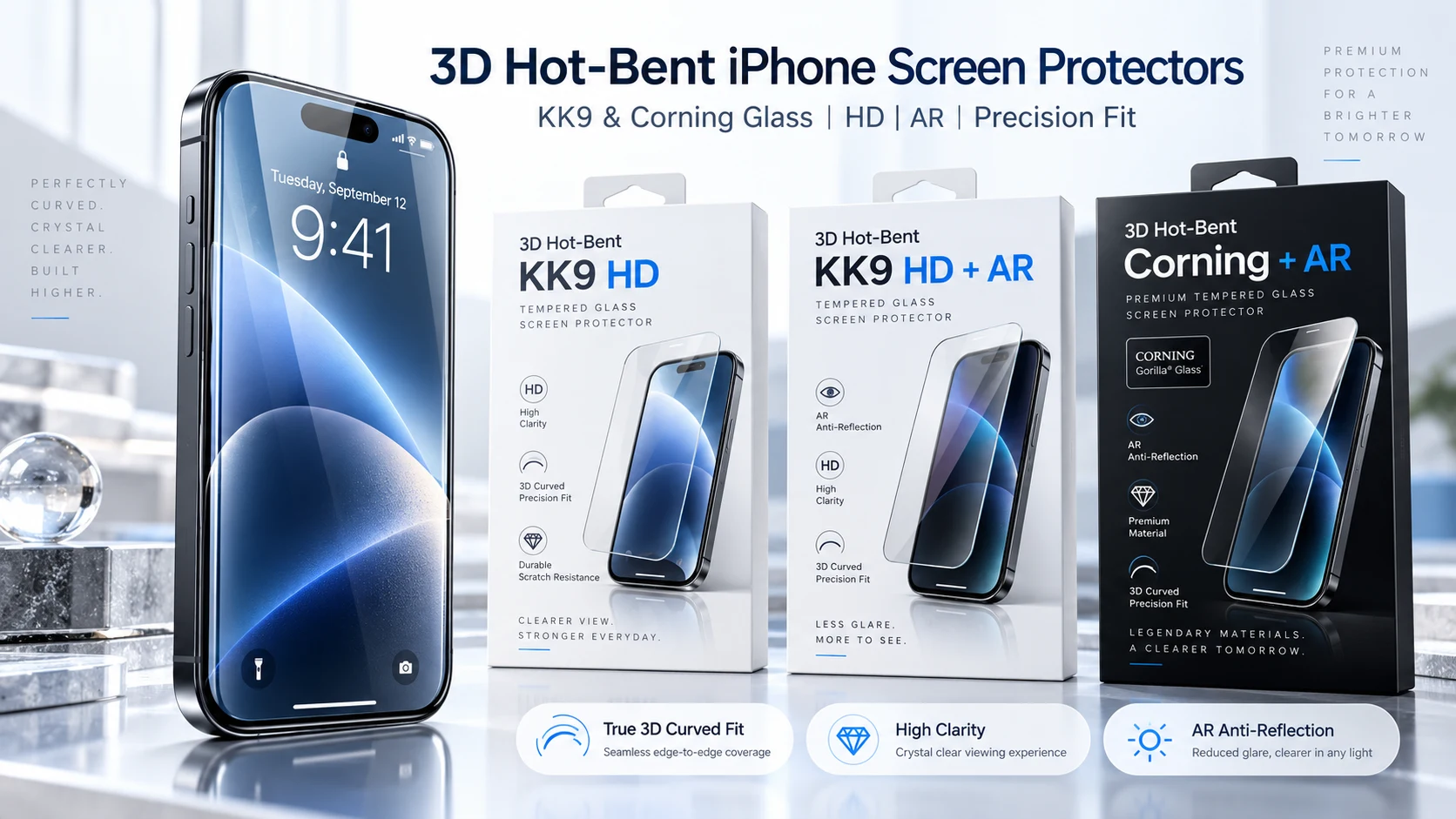
As iPhone screen quality advances, a premium protector must deliver more than a familiar hardness claim. Customers notice whether the glass follows the display edge, whether a case pushes it upward, whether reflections remain distracting, and whether the surface still feels smooth after weeks of use.
For accessory brands and distributors, these expectations create an opportunity to offer a product family with a clear upgrade path rather than three nearly identical packages. HSONE’s proposed 3D hot-bent platform brings together precision-fit design, high-clarity glass, anti-reflective (AR) options, and differentiated material sourcing.
Why 3D Hot-Bent Glass Matters
“3D hot-bent” refers to shaping glass so that its edge profile better follows a target phone’s front geometry. It is different from simply polishing a flat piece of glass with a rounded 2.5D edge. The real advantage is the fit that can be achieved when curvature, perimeter dimensions, adhesive coverage, and installation alignment are engineered as one system.
A carefully validated design can help reduce visible edge gaps and improve the feel of the protector, but 3D curvature alone does not guarantee a bubble-free result. Phone tolerances, adhesive behavior, protective-case dimensions, and the alignment tray still matter.
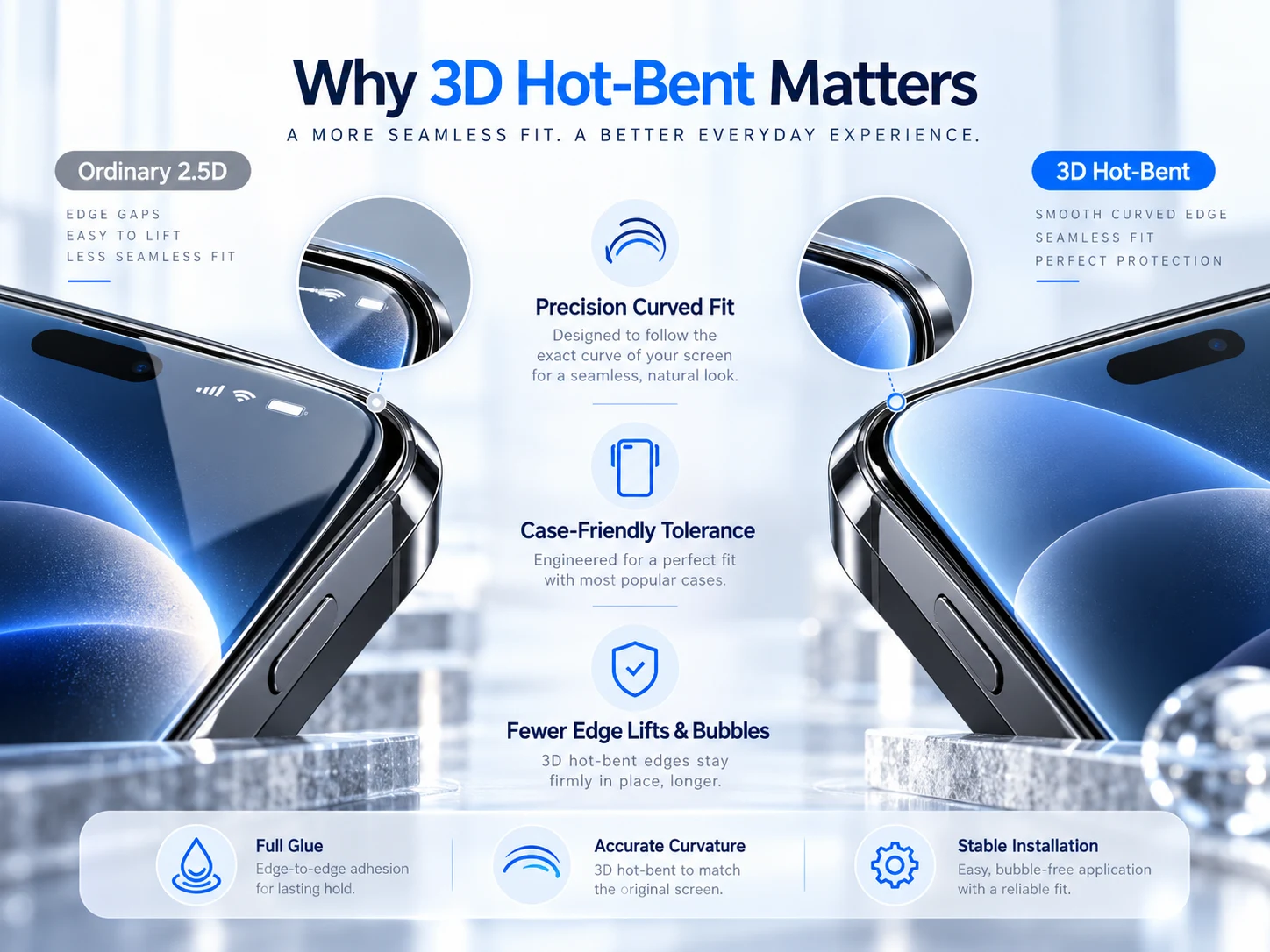 Illustrative comparison: curvature matching, case clearance, and stable adhesion must be verified on real devices.
What users notice first
- Edge lifting and bubbles after installation.
- Case compatibility and pressure around the glass edge.
- Visible borders, coverage and active-pixel clearance.
- Touch feel and fingerprint resistance from a durable oleophobic finish.
- Outdoor reflections and clarity under bright conditions.
- Installation confidence from an alignment frame and low-dust process.
One Platform, Three Premium Product Tiers
The best product ladder keeps fit quality consistent across the family. The upgrade should be easy to explain: first precision-fit clarity, then better reflection control, then higher-end glass sourcing and a stronger documented quality story.
Mainstream premium
Core upgrade
Flagship option
Tier 1 — 3D Hot-Bent KK9 HD
The accessible premium option. Its job is to deliver accurate curvature, a clean full-cover appearance, dependable adhesion, a smooth surface, and a compelling price-to-performance balance. It is suitable for channel partners that want to move customers beyond conventional low-cost flat tempered glass without making AR coating the core sales argument.
Tier 2 — 3D Hot-Bent KK9 HD + AR
The recommended hero SKU. AR technology addresses a benefit that customers can see in a side-by-side demonstration: lower surface reflections. This tier should retain the same fit and installation standards as KK9 HD while adding independently measured optical performance, color neutrality, and coating durability. Its value proposition is simple: premium protection with a clearer experience under challenging light.
Tier 3 — 3D Hot-Bent Corning + AR
The flagship concept for brands seeking stronger premium material positioning. A Corning-based construction should be backed by a verified exact glass grade, supply-chain traceability, approved naming, and processing validation after bending and strengthening. The Corning name by itself should not substitute for evidence of finished-product strength, edge reliability, or AR quality.
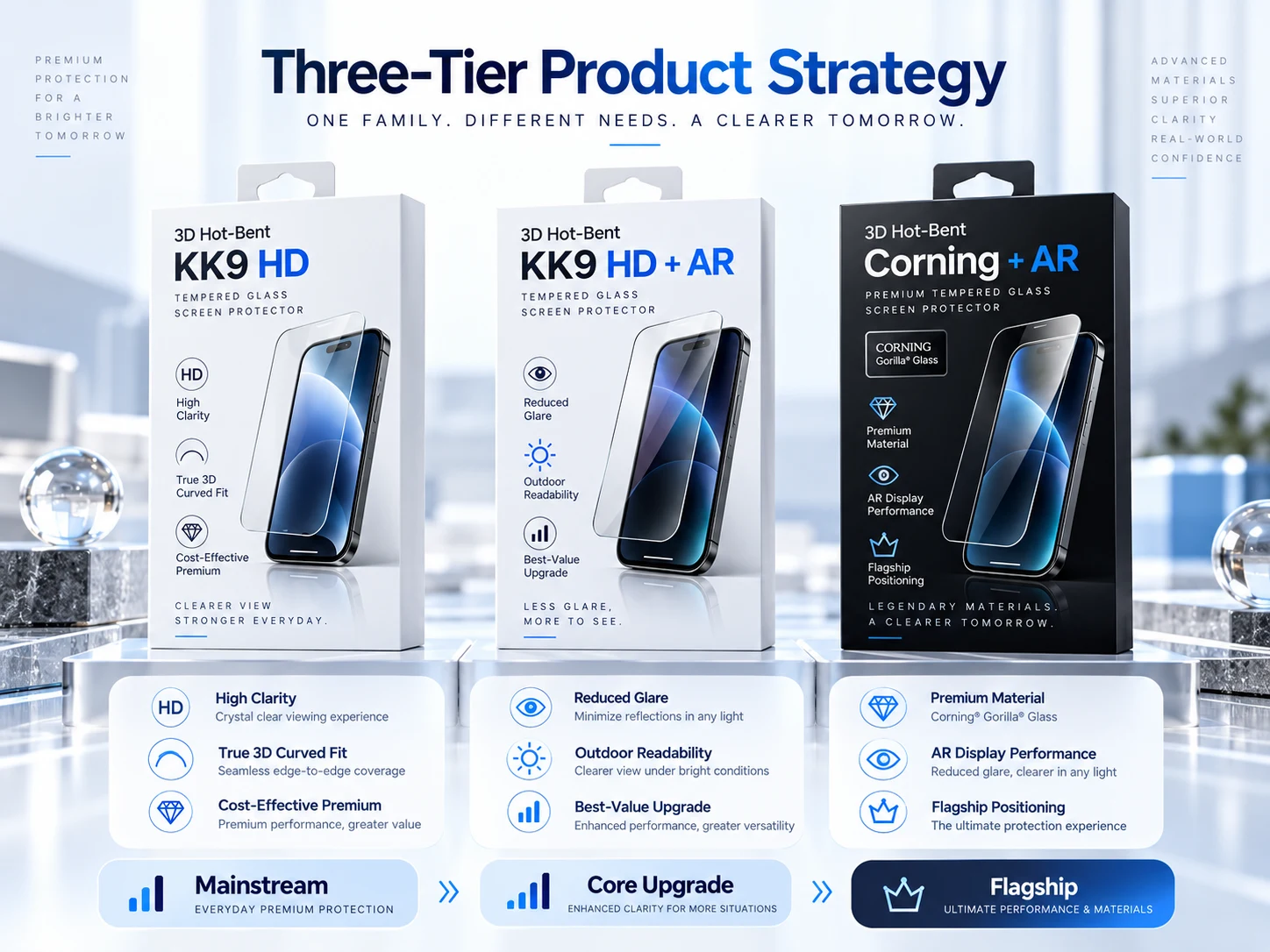 Concept positioning: KK9 HD for scale, KK9 HD + AR as the main upgrade, and Corning + AR as the flagship option.
How Buyers Should Evaluate an AR Screen Protector
“AR” should be more than a badge. The relevant specification is the optical performance of the finished protector—not just a coating sample tested on its own.
- Measure total visible-light transmittance and luminous reflectance using a stated method.
- Compare color neutrality, haze and unwanted color shift across viewing angles.
- Check the finished adhesive-and-glass stack, not only raw glass.
- Validate abrasion and cleaning durability of AR and AF layers.
- Use standardized side-by-side demonstrations alongside numerical claims.
HSONE recommends publishing verified values only after the final sample and production process have been validated.
Fit, Case Clearance, and Installation: The Real Engineering Test
Premium buyers often compare screen-edge photographs more closely than material datasheets. The design process should begin with the real target device and a defined case-compatibility set.
- Validate edge radius, corner dimensions, active-display clearance and sensor-area geometry.
- Test representative slim, rugged and raised-lip cases.
- Run installation trials with multiple users and track bubbles, edge lift and misalignment.
- Perform aging and environmental checks before approving production tolerances.
- Use revision-controlled drawings, approved samples and measurable final-inspection standards.
 3D hot-bent edges are evaluated through curved fit, case-friendly tolerance and stable installation—not curvature alone.
What Makes the Three-Tier Strategy Work for OEM/ODM Buyers?
A structured lineup simplifies product development and retail messaging. One shared model-fit platform can support differentiated optical or material constructions, while controlled packaging and installation accessories create a consistent customer experience across the family.
A clearer retail upgrade path
KK9 HD is the dependable starting point; KK9 HD + AR gives customers a visible reason to upgrade; Corning + AR offers a premium story for channels that value documented sourcing and deeper quality validation.
More credible private-label differentiation
Customization may include finish, black-border design, packaging, installation trays, labels, barcode systems and target-market documentation. The product family should be built around specified tests and approved samples rather than generic catalog claims.
OEM Buyer Checklist
- Which KK9 specification and thickness are supplied, and is every lot traceable?
- What is the exact Corning glass grade, and what usage rights apply to material names and logos?
- Which process stages use heat bending, strengthening, AR coating, AF treatment and adhesive lamination?
- What is the finished-product reflectance and transmittance under a documented method?
- How are edge geometry and case-fit tolerances inspected across production lots?
- What installation accessories, private-label options and sample revisions are available?
- Which impact, abrasion, coating and environmental test results can be provided?
Frequently Asked Questions
Is 3D hot-bent glass automatically case-friendly?
No. Case compatibility still depends on edge clearance, glass dimensions, adhesive behavior and the case lip. Test actual phone-and-case combinations before making a broad compatibility claim.
Is KK9 HD + AR always better than KK9 HD?
It is a different value proposition. KK9 HD targets clear, reliable daily protection at a competitive price, while KK9 HD + AR targets users who value reduced reflections. The AR benefit should be demonstrated and measured on the finished product.
How should brands compare KK9 and Corning glass?
Compare verified grades, thickness, strength and edge tests, processing yield, source traceability and final-product performance. Material names alone are not a substitute for approved samples and a defined test protocol.
What should an OEM sample kit include?
Ask for final-stack samples of all three tiers, installation accessories, test documentation, batch identifiers and a fit-validation checklist.
Build a Better Premium Screen Protector Line With HSONE
The next opportunity in iPhone screen protection is not simply selling harder glass. It is delivering precision fit, a better daily viewing experience and a product upgrade story supported by validation. The KK9 HD → KK9 HD + AR → Corning + AR ladder offers a practical way to address different price levels while protecting a consistent premium positioning.
HSONE supports OEM/ODM collaboration across product definition, sampling, glass and coating options, fit validation, private-label packaging and quality-control planning.
Build Your 3D Hot-Bent Product Line
Discuss OEM/ODM, private-label and sampling options for KK9 HD, KK9 HD + AR and Corning + AR programs.
For adjacent product planning, compare our 20° Privacy screen protector platform alongside 3D hot-bent glass.
Discuss OEM/ODM Options Explore Products View iPhone 18 Pro SolutionsPublishing note: The three visuals in this article are concept illustrations. Final material grades, trademarks, optical results, sample lead times and production claims should be confirmed against approved samples and applicable test documentation before commercial use.