
2026-09-30
Does Privacy Screen Protector Affect iPhone 18 Pro Face ID?
What Brands, Distributors and OEM Buyers Need to Know
The Short Answer
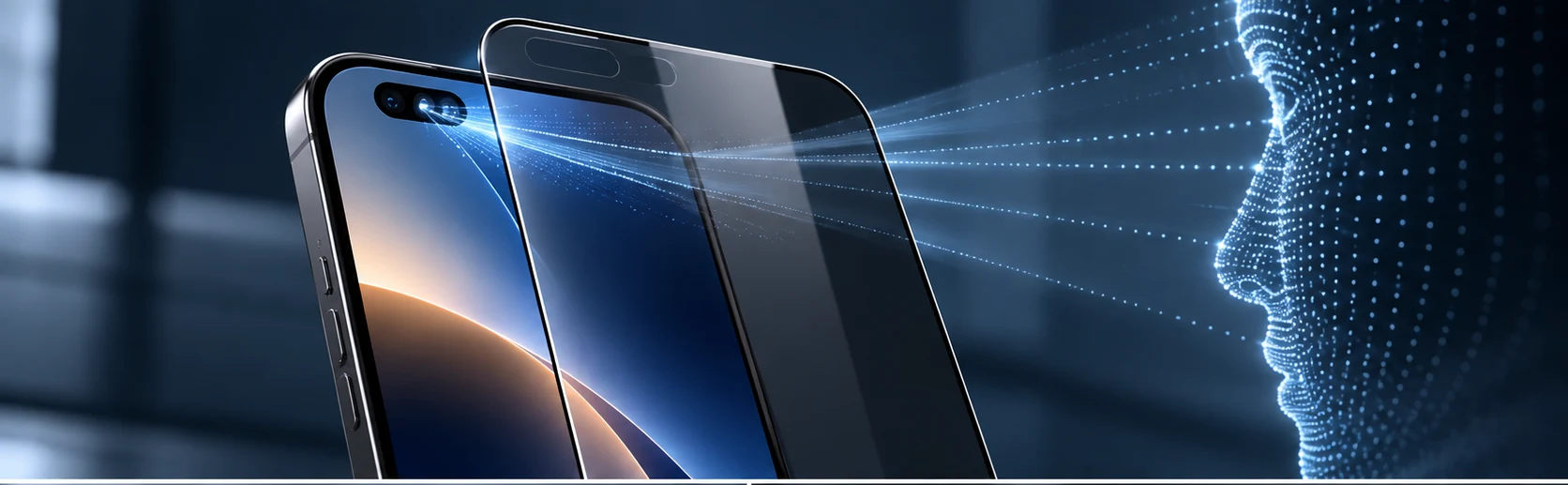
A privacy screen protector can affect Face ID on iPhone 18 Pro or iPhone 18 Pro Max if its optical structure, printed border, surface treatment, or installation interferes with the TrueDepth camera area. But this does not mean every privacy protector will fail.
Apple’s current Face ID support guidance says that on iPhone 18 Pro models the TrueDepth camera is located at the top of the device toward the left corner, and advises users to remove anything that may cover it, including a screen protector, when troubleshooting Face ID. This makes sensor-area design and real-device validation especially important for accessory brands.
Why iPhone 18 Pro Changes the Screen-Protector Conversation
With previous generations, many buyers focused primarily on Dynamic Island clearance and overall fit. On iPhone 18 Pro models, the location of the TrueDepth camera toward the upper-left area means a protector can interact with the sensing path even when the visible Dynamic Island looks unobstructed.
That matters most for optical products such as privacy and matte protectors. These products intentionally change the way light travels through the protector. Privacy structures restrict off-axis visibility; matte surfaces scatter reflected light to reduce glare. Both can deliver valuable user benefits, but their optical behavior needs to be evaluated around the sensing area.
What Real-World Users Are Reporting
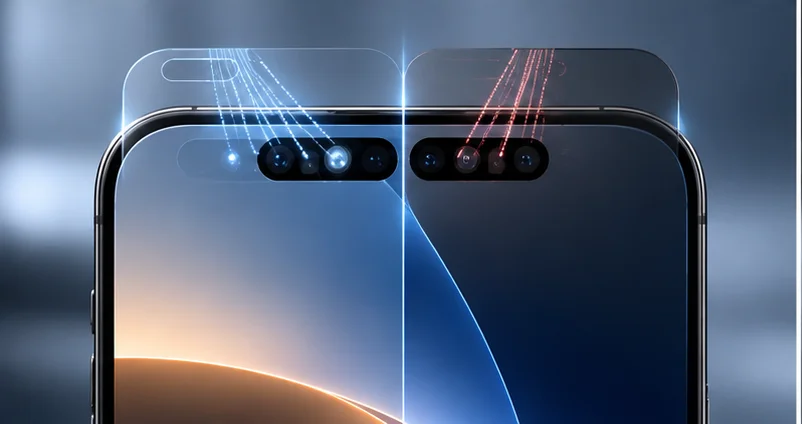
Early user reports after the iPhone 18 Pro launch are mixed. Some users report normal Face ID performance with privacy or privacy-matte protectors, while others report failed enrollment, slower unlocking, or worse performance in certain conditions. Other users have also reported Face ID issues without a protector, so individual anecdotes should not be treated as proof that a particular material always causes the problem.
For manufacturers, the useful signal is the variation itself. If two products sold under the same broad category produce different outcomes, the engineering question becomes: what differs in the optical stack, sensor-area treatment, printed border, alignment, adhesive, or installation?
Five Design Variables That Matter
1. Sensor-area optical transmission
The material above the TrueDepth camera must allow the sensing system to operate reliably. Visible-light transparency alone is not enough to characterize performance. A protector can look clear to the human eye while behaving differently at wavelengths used by sensing systems.
2. Privacy-layer construction
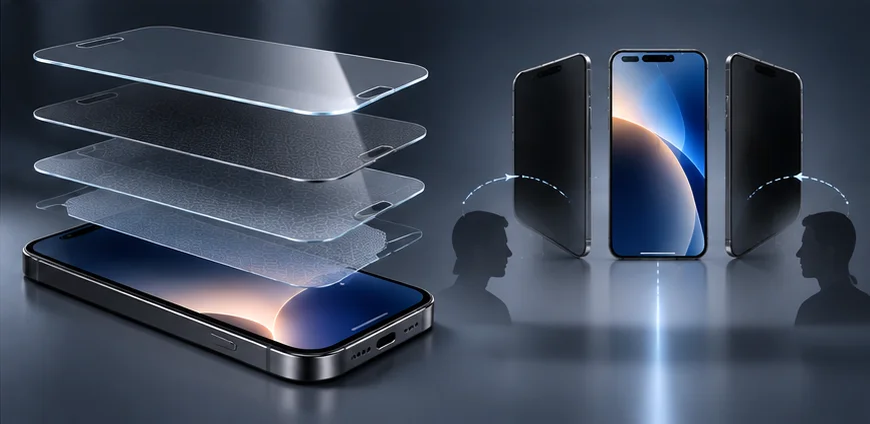
Privacy glass commonly uses micro-louver or other directional optical structures to narrow the viewing angle. The exact construction, orientation and density influence both privacy performance and total transmission. Stronger privacy is not automatically better if it compromises front-view brightness or device functionality.
3. Matte and anti-glare treatment
Matte surfaces reduce reflections by scattering light. That same scattering behavior is why a matte construction deserves separate Face ID testing rather than being approved simply because the clear version passed.
4. Black border and cutout geometry
A border or masking layer that is slightly misplaced can create a functional problem even when the base glass is optically suitable. Tolerances around the upper-left sensing area should therefore be included in drawing review and incoming inspection.
5. Installation position
A well-designed protector can still fail if an installation tray or manual application allows excessive positional variation. Brands should validate not only the ideal laboratory placement but also realistic installation tolerances.
How HSONE Recommends Validating an iPhone 18 Pro Privacy Protector
For a B2B program, compatibility should be converted into a repeatable test plan. The goal is not to prove that one hand-built sample works once; it is to confirm that production variation still leaves enough margin for reliable use.
- Test iPhone 18 Pro and iPhone 18 Pro Max separately on real devices or verified production-standard fixtures.
- Run Face ID enrollment and repeated unlock cycles before and after protector installation.
- Test straight-on use plus reasonable off-axis positions and portrait/landscape handling.
- Repeat tests in bright indoor light, lower-light environments and typical nighttime use conditions.
- Compare clear, privacy, privacy-matte and matte constructions independently rather than transferring approval from one material to another.
- Measure alignment tolerance around the upper-left sensing area and verify the installation tray controls placement.
- Record failures by sample lot and position so mold, printing or optical-layer changes can be traced.
- Revalidate after any change to glass, adhesive, privacy film, coating, border printing or supplier.
Should Brands Use a Clear Window Over the Sensor?
A localized clear area is one possible engineering approach, but it should not be presented as the only solution. A clear window may improve the optical path, yet it can create a visible discontinuity in privacy coverage and may be undesirable for customers who expect uniform appearance.
Another approach is to optimize the privacy construction itself and validate that the sensing system remains reliable through the material. The right choice depends on the required privacy angle, brightness target, aesthetics, sensor performance, manufacturing tolerance and price position.
What OEM/ODM Buyers Should Ask Before Mass Production
- Was Face ID tested on production-representative iPhone 18 Pro and Pro Max samples?
- Does the privacy layer cover the TrueDepth camera area, and if so, what validation supports that design?
- Is there a dedicated clear zone, micro-cutout or optical optimization around the sensor area?
- What is the specified privacy viewing angle, and how is it measured?
- How much front-view brightness/transmittance is lost versus the clear version?
- Are black-border tolerances and installation-tray tolerances included in QC?
- Will a material or coating change trigger compatibility revalidation?
- Can the supplier provide test records, approved samples and revision-controlled drawings before mass production?
Privacy Performance Is More Than a Viewing-Angle Number
For retail marketing, a narrow privacy angle is easy to communicate. For product development, however, the better target is balanced performance. Buyers should evaluate side-view darkening together with front-view clarity, color neutrality, brightness, touch response, fingerprint resistance, case compatibility, installation yield and Face ID reliability.
This is also where OEM/ODM development can create meaningful differentiation. Rather than offering one generic privacy glass, a brand can define a product around its channel: stronger privacy for business users, brighter privacy for everyday retail, matte privacy for glare-sensitive users, or premium full-cover glass with optimized sensor-area performance.
HSONE OEM/ODM Development Approach
HSONE works with brands, distributors and retail programs on customized screen-protector development. For iPhone 18 Pro privacy projects, the development process can include fit and sensor-area review, privacy specification, glass and coating selection, border design, installation-tool development, packaging, private-label branding, sampling and production quality control.
For new-device launches, the key is fast iteration with controlled validation. A rapid sample is valuable only when the next decision is clear: approve, revise the optical construction, adjust the sensing area, change the border, or refine the installation tolerance.
Conclusion
So, does a privacy screen protector affect Face ID on iPhone 18 Pro? It can—but the outcome depends on the exact product design and installation. Apple’s own troubleshooting guidance makes the screen protector a relevant variable, while early user reports show that some privacy constructions work and others do not.
For brands and distributors, that is an engineering opportunity rather than a reason to abandon the category. A privacy protector designed around the iPhone 18 Pro sensing layout, tested on real devices and controlled through production can offer privacy without treating authentication performance as an afterthought.
Developing an iPhone 18 Pro privacy screen protector? Contact HSONE for OEM/ODM sampling, private mold support, optical customization and production validation.
Sources & Editorial Notes
Apple Support, “If Face ID isn’t working on your iPhone or iPad Pro,” updated September 2026. Apple notes that on iPhone 18 Pro models the TrueDepth camera is toward the top-left and advises removing anything that may cover it, including a screen protector.
Reddit discussions in r/iphone and r/iphone18pro, September 18–30, 2026. User reports are mixed and are used only as market-discussion signals, not controlled technical evidence.
Editorial note: product compatibility must be verified on production-representative devices and samples. This article does not claim that all privacy or matte protectors interfere with Face ID.